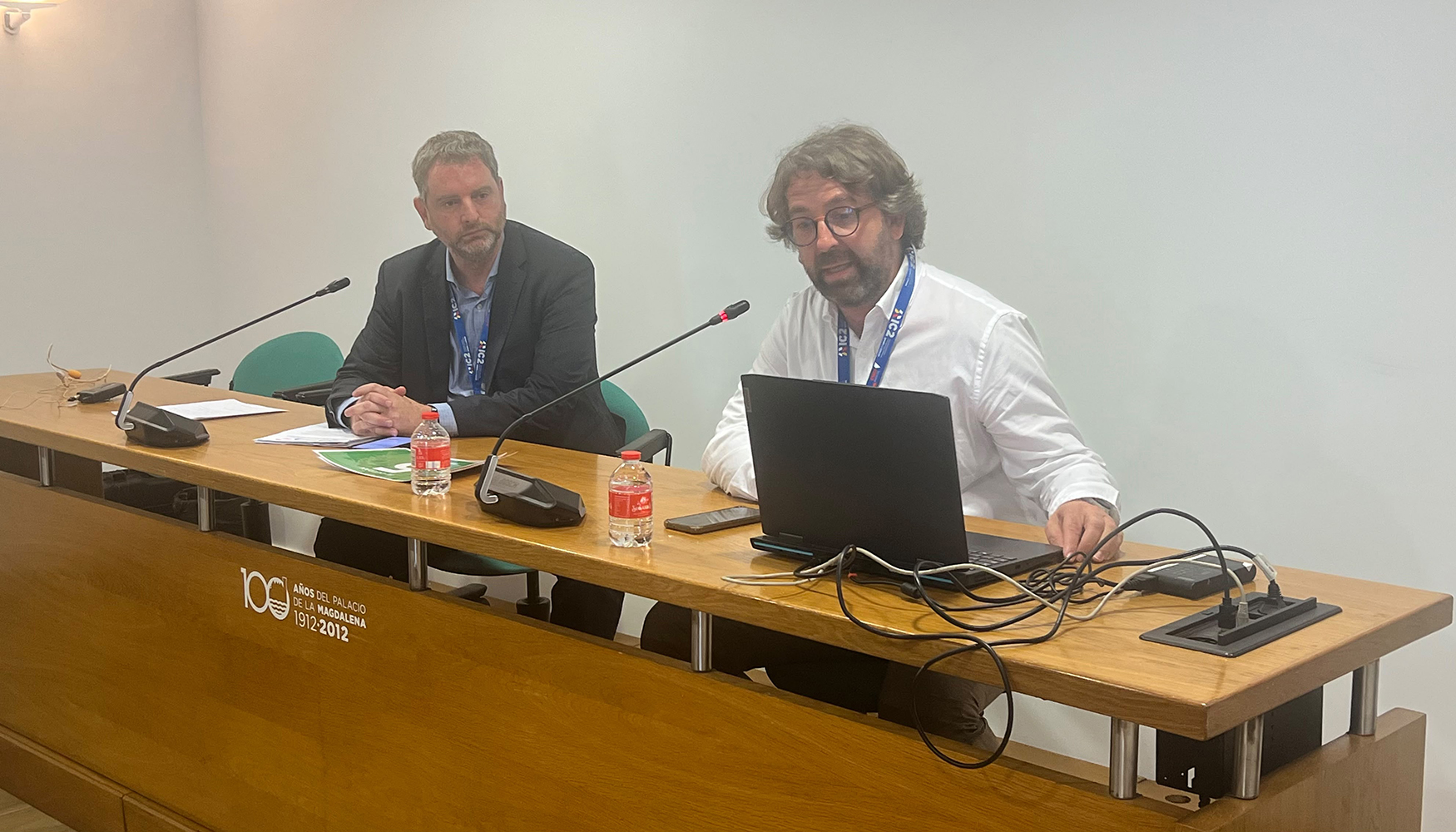
H2MAC Project presented at I2C Congress
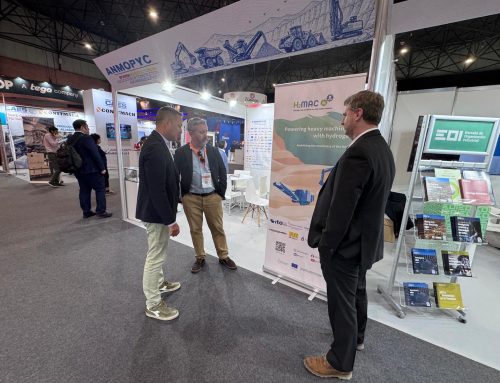
IC2 Congress (Innovation Industry Construction Congress), the leading international event for innovation in construction, building, and infrastructure, co-organized by the Spanish Construction Technology Platform (PTEC), was held in June 1-5, 2026 in Santander (Spain).
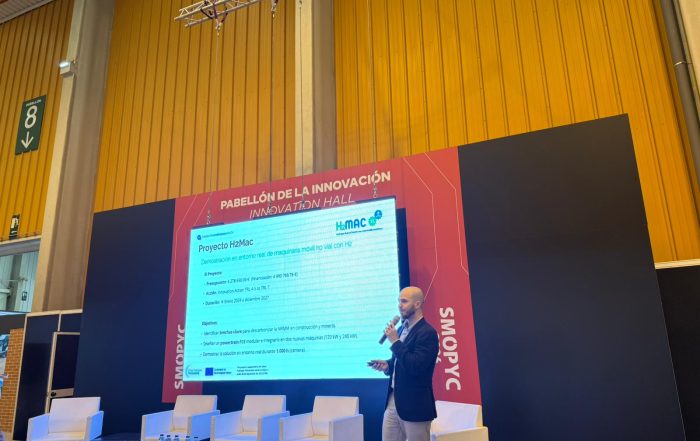
The I2C Congress devoted significant attention to machinery, thanks to the sponsorship of ANMOPYC and the coordination of its technical advisor, Sergio Serrano, under the heading“Machinery in Action: Transforming Construction and Demolition.” The event featured an entire morning of highly interesting sessions, with particular emphasis on the presentation by David Díez from the Aragon Institute of Technology (ITA) on the integration of hydrogen fuel cell systems.
The European H2MAC project is working on the development and validation of construction and mining machinery powered by fuel cells, a technology expected to play a key role in the decarbonization of high-power equipment. The machinery of the future will not only be more productive. It will also be cleaner, more efficient, and smarter.
The decarbonization of non-road mobile machinery (NRMM), particularly equipment used in construction, mining, and earthmoving applications, represents one of the greatest technological challenges currently facing the industry. The sector’s heavy reliance on diesel fuel, CO₂, NOx, and particulate emissions, noise impact, and the high energy demands of these applications create significant limitations for conventional battery electrification, especially in machines operating through long work shifts and under high power requirements.
Against this backdrop, hydrogen is emerging as one of the most promising alternatives for achieving zero-emission machinery. Among the available options, fuel cells stand out as the most promising technology due to their high energy efficiency, their ability to eliminate local emissions, and their natural integration with electric propulsion systems. By contrast, hydrogen combustion engines retain architectures similar to current systems, but offer lower efficiency levels and do not completely eliminate NOx emissions.
It is precisely to accelerate the deployment of this technology in real-world applications that H2MAC was launched. This European project aims to bridge the gap between the enormous theoretical potential of fuel cells and their industrial validation in heavy machinery. While the technology has demonstrated significant progress in other mobility sectors, important uncertainties remain regarding its reliability in demanding environments such as quarries, mining operations, and construction sites, where machines must withstand dust, vibrations, impacts, and extremely intensive duty cycles.
“Machinery is a strategic area of work,” began David Díez in his presentation, “and hydrogen is a new vector for transforming heavy construction machinery.”
The ITA-led initiative is focused on developing a new generation of electric powertrains based on hydrogen fuel cells. As part of the project, two representative heavy-machinery prototypes are being developed: a 120 kW excavator from Hidromek and a 240 kW mobile crushing unit (ZB). Both machines will share a common architecture for hydrogen and electrification systems, following a modular and scalable philosophy that will later allow the technology to be adapted to different machine types and sizes. The objective is to achieve performance levels equivalent to those of today’s diesel-powered equipment while eliminating their major environmental impacts.
One of the most significant aspects of the project is its comprehensive approach. It is not simply a matter of replacing an internal combustion engine with a fuel cell; rather, it involves designing an entirely new energy architecture. To achieve this, work is underway on the development of hybrid fuel cell-battery systems, hydrogen storage and distribution systems, advanced power electronics, dedicated thermal management systems, and new intelligent control strategies aimed at optimizing energy consumption and maximizing operational efficiency.
Digitalization also plays a fundamental role. The project includes the development of multiphysics digital twins capable of replicating the complete behavior of the machine, as well as predictive energy management systems that optimize hydrogen utilization according to operating conditions. All of this is intended to ensure maximum efficiency without compromising equipment productivity.
Key Facts
- Two heavy machinery prototypes powered by fuel cells: a 120 kW excavator and a 240 kW crusher/shredder.
- More than 1,000 hours of validation under real operating conditions between 2027 and 2028.
- Expected reduction of 170 tonnes of CO₂ per year.
- Operational noise reduction of between 10 and 12 dB(A).
- Direct application in construction, mining, and non-road mobile machinery.
One of H2MAC’s greatest distinguishing features will be its validation under real operating conditions. Rather than being limited to laboratory testing, the two prototypes developed will work simultaneously in a quarry located in Arcos de la Frontera (Cádiz), where they will accumulate more than 1,000 operating hours during 2027 and 2028. This phase will make it possible to evaluate critical aspects such as reliability, durability, energy performance, and the behavior of hydrogen systems in real industrial environments.
Beyond its technical results, H2MAC represents a strategic step forward for the entire construction and mining industry. The initiative aims to demonstrate that fuel cells can become a viable alternative for applications where battery electrification is insufficient, particularly at sites located far from the power grid or with very high energy requirements. Ultimately, the project seeks to redefine the concept of sustainable heavy machinery and accelerate the transition toward a construction and mining model with lower emissions and greater energy efficiency
Latest News
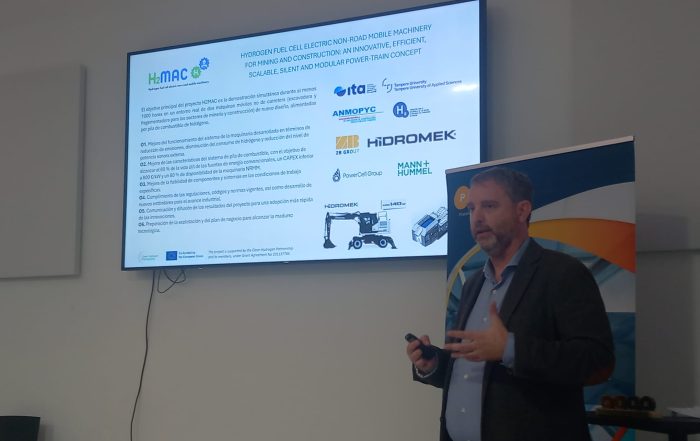
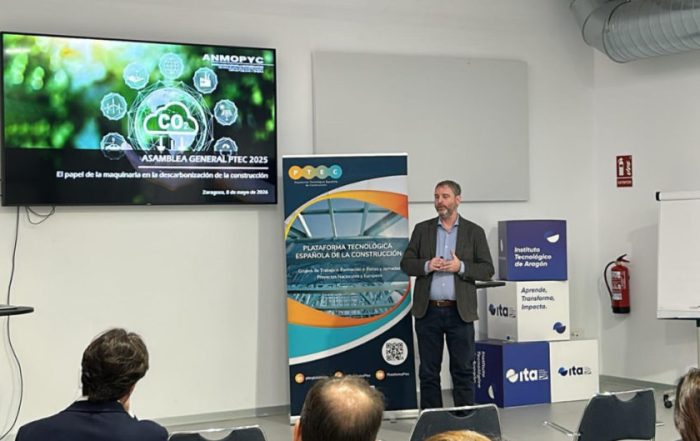
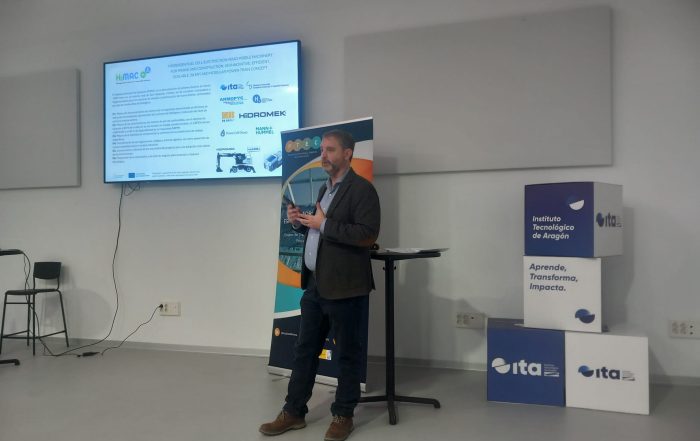
ANMOPYC presented H2MAC Project at PTEC 2026 General Assembly
On May 7 and 8, the Spanish Technological Platform for Construction (PTEC) held its annual
ITA gives update on machine fuel cell conversion project
Power Progress magazine, part of KHL Group, has published an article at the SMOPYC construction
H2MAC at SMOPYC 2026: innovation in a high-impact environment
Our participation in SMOPYC 2026, the International Exhibition of Public Works, Construction and Mining Machinery,